
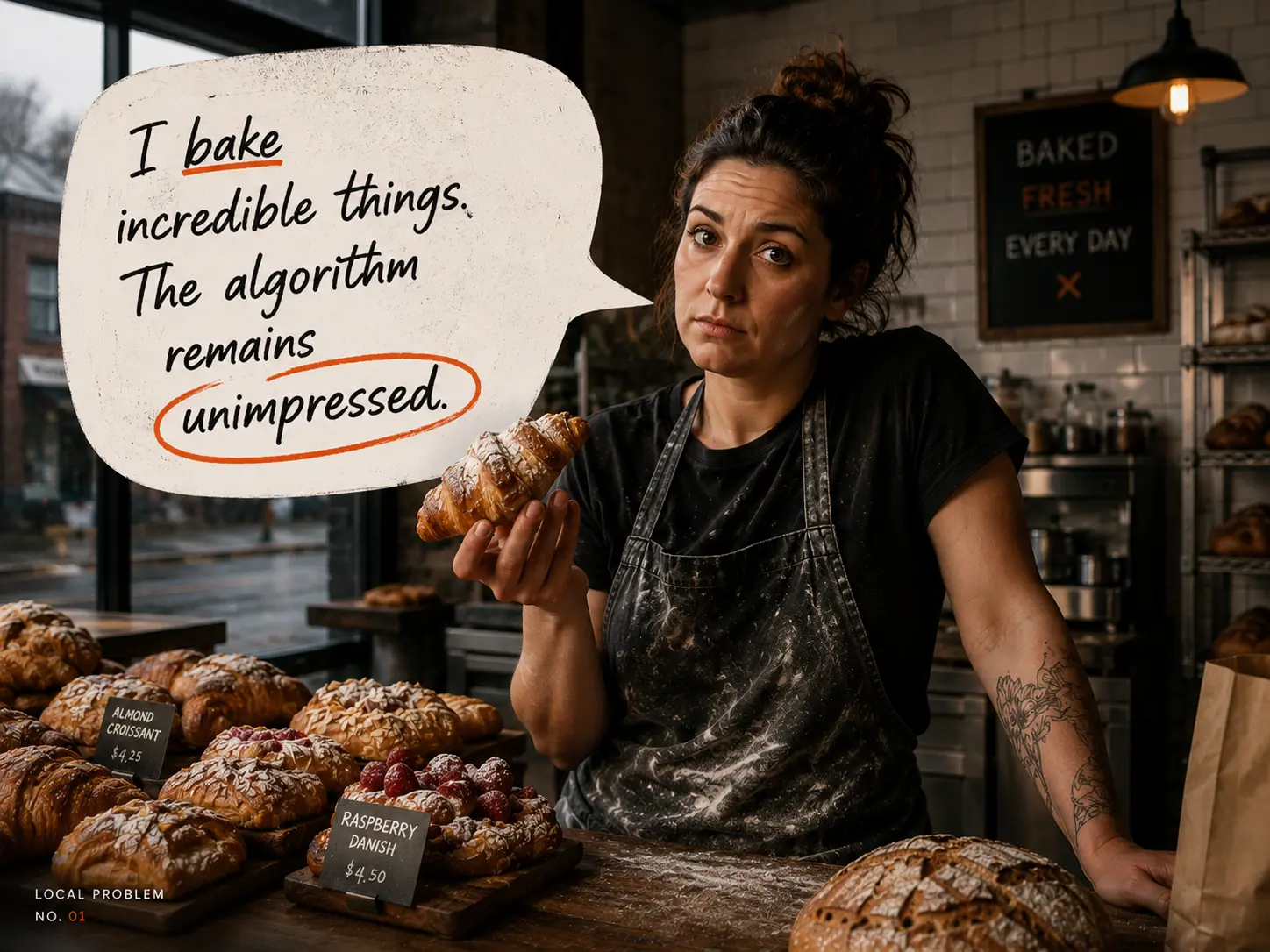
I was listening to a podcast clip a few weeks ago that I haven't been able to put down. On WTF is with Nikhil Kamath, Nikhil sat down with the founders behind some of India's biggest craft-beverage brands — Matt Chitharanjan of Blue Tokai, Rahul Reddy of Subko, and the founders of Svami and Mossant — for an episode about what it actually takes to build a beverage brand in a market this saturated.
Nikhil floated a scenario: imagine a 25-year-old in Mumbai who wants to open a café on a street where Blue Tokai and Subko already have locations. Two of the country's most recognized specialty coffee names, right next door to each other. What should that 25-year-old actually do to have a shot?
The first answer was a product answer. Product answers get copied.
One instinct on the panel was: compete on selection. Instead of pouring only your own beans, become a multi-roastery — curate coffee from roasters around the world, and win on range and discovery rather than a single house blend. It's a reasonable strategy, and it's exactly the kind of expansion Blue Tokai itself has pursued on its way to becoming one of India's largest specialty coffee networks, now operating well over 100 cafés across India and Japan.
But here's the problem with any strategy built entirely on the product: it's the easiest thing on the table to copy. If a multi-roastery format works, the incumbent next door can add guest roasters within a fiscal quarter. A better espresso machine, a wider bean selection, a new brewing method — none of it is defensible for long, because none of it requires anything the competitor down the street can't also buy. Product moats in small, service-heavy businesses are almost always weaker than the founder building them believes.
The other answer wasn't about coffee at all.
Rahul Reddy's answer, by contrast, wasn't a coffee strategy — it was an identity strategy. Reddy has said openly in interviews that Subko was built to ask a different question than most Indian specialty cafés before it: does a specialty coffee shop have to look and feel like it belongs in Copenhagen or New York to be taken seriously? "What if we could build an exportable brand that clearly originated from the subcontinent?" is roughly how he's put it — Subko is deliberately built as a retail space, café, roastery, and bakehouse in one, designed around South Asian visual identity, and it regularly runs storytelling nights and workshops with local artists, designers, and musicians rather than just selling coffee across a counter.
That's the same instinct behind the version of the idea Nikhil's question was really getting at: instead of a multi-roastery, the real moat might be a collection of old vinyl records, or a room where local artists paint every Saturday, or a corner devoted to one specific cultural thread — Bengali literature, Marathi poetry, old photographs of the city, a running discussion series on architecture and film. Something a bigger competitor with more capital and a better supply chain still can't simply order and install.
There's a name for this, and it's older than any coffee brand alive.
In 1989, the American sociologist Ray Oldenburg published The Great Good Place, which gave the idea a name that's stuck ever since: the third place — not home, not work, but the informal, semi-public space in between, where relationships and identity actually get built. Cafés, barbershops, pubs, and bookstores have always functioned this way when they're doing their job properly. Oldenburg's argument, decades before "community-led growth" was a term any marketer used, was that the third place is "the heart of a community's social vitality" — and that a business built around one stops competing on price the moment it becomes one.
That's the mechanism underneath Rahul Reddy's answer. He isn't proposing decoration. He's proposing that Subko become somebody's third place, the way the best neighborhood café, the best local bookstore, or the best small gym always eventually does — and that a competitor with a bigger balance sheet cannot simply buy their way into a role that has to be earned one regular customer at a time.
The trap: it's easy to buy the aesthetic and skip the actual community.
Here's where I'd push back on anyone who hears this and reaches straight for a vintage-furniture supplier. Buying a stack of old vinyl, hanging local photographs, and putting a typewriter on a shelf is decor — and customers can tell the difference between decor and a genuine subculture almost instantly. A "community-driven" sign on the wall convinces nobody. Fifty people who show up every single week because the ritual actually means something to them — that convinces everyone, including people who've never been inside.
The moat was never the vinyl collection. The moat is the fifty people who return because of it.
Canada already ran this experiment — and it's worth studying both outcomes.
This isn't a uniquely Indian or uniquely café-shaped idea. Two of Canada's most instructive brand stories are really the same story about culture-as-moat, told in opposite directions.
lululemon didn't out-grow Nike and Adidas in athletic wear by out-spending them on advertising. Its early growth ran almost entirely on a grassroots ambassador model — recruiting respected local yoga and fitness instructors in each market, giving them free product, and hosting their classes directly inside stores, building what the company still calls its "sweatlife" community around sweating, growing, and connecting together. Competitors with far larger marketing budgets spent years trying to replicate a community effect that had already compounded, market by market, class by class, for a decade.
Mountain Equipment Co-op tells the harder half of the same lesson. Six mountaineers from the UBC Varsity Outdoor Club started MEC in Vancouver in 1971 to sell gear to a community of climbers and hikers nobody else was serving properly. For nearly fifty years, MEC's entire identity was built on being member-owned — a genuine cooperative that reinvested in Canadian outdoor culture and put roughly $44 million into conservation and recreation causes since 1987. Then, after the co-op declared bankruptcy in 2020, its brand and assets were sold to a Los Angeles private equity firm for a reported $150 million, and the "co-op" was quietly dropped from the name. More than 100,000 members signed a petition against the sale within days. The Walrus put the loss more bluntly than I could: MEC had already lost the mountain from its brand years earlier — and with the sale, "it has lost the co-op from its spirit. All that's left is equipment."
Put those two next to each other and the lesson is uncomfortable but clear: the community is the actual asset. lululemon built one and kept compounding it. MEC built one, arguably one of the strongest brand-community stories in Canadian retail history, and then let the very thing that made it valuable get sold off as if it were interchangeable with the inventory.
This isn't a café idea. It's every saturated category right now.
The same principle explains why certain gyms, bookstores, and even motorcycle brands survive against much larger, better-capitalized competitors. Harley-Davidson didn't out-engineer Honda or Yamaha on horsepower-per-dollar — it built the Harley Owners Group in 1983, which grew from roughly 30,000 founding members to more than a million riders across 25 countries, turning ownership itself into a standing community of rides, rallies, and chapters that a competitor's better-spec motorcycle simply can't buy its way into. Soho House built a global hospitality business — 40-plus locations, 260,000-plus members, a waitlist over 100,000 people deep — while spending under 2% of revenue on traditional advertising, because the exclusivity and the community were the product, not the rooms.
The underlying shift is one worth sitting with: as products, ingredients, and even AI-assisted services become more similar across competitors, identity is one of the few things that doesn't commoditize on the same timeline.
If I were that 25-year-old — or a Saskatoon owner opening beside a bigger chain — here's the actual sequence I'd build in.
Not ten things at once. In order:
- Baseline: the product still has to be genuinely good. Nobody tolerates weak coffee, or a mediocre service, because the room has character. Culture buys you loyalty on top of quality — never instead of it.
- Identity: pick one cultural lane, not ten. A café that tries to be the Bengali-poetry spot, the vinyl-jazz spot, and the architecture-discussion spot all at once ends up memorable as none of them.
- Ritual: build one recurring event on a fixed schedule — a listening night, a sketch club, a local-authors reading — and run it for at least three months before judging whether it's working.
- Participation: let customers contribute, not just consume. Pin their photos. Display their art. Archive local stories on the wall. The room should visibly belong to the regulars, not just the owner.
- Mythology: give people a story they'll actually retell to someone else. Humans don't just buy products — they collect and repeat stories. That retelling is the cheapest, most durable marketing channel there is, and it's the one a bigger competitor's ad budget can't simply outspend.
The one caution I'd add before anyone runs with this.
Culture can't be reverse-engineered over a weekend. A café — or a gym, or a bookstore, or a clothing brand — that tries too hard to look "artsy" or "heritage" without the years of real participation behind it usually ends up feeling like a movie set instead of a place. The founders who pull this off convincingly are almost always the ones who genuinely belong to the subculture they're building around, not the ones who hired a design firm to simulate it. That's the actual filter: are you hosting an identity you already live inside of, or decorating a room to look like one you read about?
Trying to figure out what actually makes your business memorable — not just decorated?
Frequently Asked Questions
Does building a subculture around a business actually work, or is it just decor?
It only works if people participate, not just look. Vinyl records on a shelf or vintage photos on a wall are decoration. A recurring event that fifty people show up to every month — a listening night, a sketch club, a language table — is culture. The test is simple: if you removed the owner for a month, would the ritual still happen because the community wants it to? If yes, it's real. If no, it's a theme.
Isn't it risky to focus on identity and community instead of just making the product better?
The product still has to hold its own — nobody keeps returning to a café with bad coffee because the wallpaper is interesting. Community is not a replacement for quality; it's what makes quality memorable enough to survive a bigger, better-funded competitor opening next door with a better paper spec sheet.
Can a small business in Canada actually compete with a bigger brand using this approach?
Yes — arguably better than in most markets, because Canada has a strong track record of it. lululemon out-grew global athletic-wear giants using local ambassadors and community classes instead of celebrity ads. The lesson scales down just as well: a single Saskatoon business built around a real local identity can out-compete a bigger, better-funded chain on loyalty, even without matching its marketing budget.
What's the fastest way to start building this kind of identity for an existing business?
Pick one cultural lane instead of ten, and commit to a single recurring ritual — one event, on a fixed schedule, for at least three months before judging it. A weekly sketch night, a monthly local-authors reading, a Saturday chess table. The specific ritual matters less than the repetition; culture is built by things that happen reliably, not by one clever launch event.
Sources
- Business Today — Nikhil Kamath, Blue Tokai & Subko founders on India's craft-coffee market (WTF is with Nikhil Kamath, Ep. #22)
- The Hard Copy — The Subko story: building a subcontinental specialty-coffee identity
- Startuppedia — Blue Tokai's rise to 135+ outlets under Matt Chitharanjan and Namrata Asthana
- Ray Oldenburg — "The Great Good Place" (1989) and the third-place concept
- lululemon's community-led growth strategy and ambassador model
- Wikipedia — Mountain Equipment Co-op, founding (1971) and conservation contributions
- The Walrus — How MEC lost touch with its roots after the 2020 sale to Kingswood Capital
- Harley-Davidson — Harley Owners Group (H.O.G.), founded 1983
- Advertising Week — Soho House's membership and community model
Keep reading
- Marketing Is the Most Important Department in Your Business — the companion argument: perception, not product, sets your price.
- The C × AOV × F Formula — how loyalty and repeat visits (the F in the formula) are exactly what a real community compounds.
- Google Local Services Ads, Explained — how a local business gets found before it's ever had the chance to build a subculture around it.